Complex PTSD vs PTSD: Why the Difference Changes Treatment
A board-certified anesthesiologist explains who qualifies for ketamine infusion therapy, what we screen for, and who we turn away. Milford & Westport, CT.

Written by Dr. Gino Ang, MD, Board-Certified Anesthesiologist | Medically reviewed by Dr. Gino Ang, MD | Est. reading time: 9 minutes
A patient once described it to me this way. The flashbacks were only part of it, and honestly not the worst part. The worst part was that she did not trust a single person she had ever met, could not hold a feeling steady for more than an hour, and had believed since childhood that there was something fundamentally wrong with her as a person.
She had a PTSD diagnosis. It was not wrong. It was just incomplete, and the incompleteness had shaped years of treatment that never quite fit.
What she was describing has a name. It is called complex PTSD, and whether your clinician uses that term depends partly on which diagnostic manual they work from.

Post-traumatic stress disorder is built around three things happening after a traumatic event.
That is PTSD. It is real, it is well studied, and it responds to treatment.
Complex PTSD includes all three of those clusters, and then adds a second set of problems that sit at the level of personality and self rather than memory. In the World Health Organization’s ICD-11, these are grouped under the heading disturbances in self-organization, and all three must be present.
The second thing to know is that ICD-11 treats these as mutually exclusive. You are diagnosed with PTSD or with complex PTSD, not both.
This is the part that causes real confusion, so I want to be direct about it.
Complex PTSD is a formal diagnosis in the ICD-11, which is the World Health Organization’s system. It is not a separate diagnosis in the DSM-5-TR, which is what most American clinicians use day to day.
So an American psychiatrist may recognize everything described above, understand it well, and still write PTSD on your chart, because that is the code available. That does not mean they missed it. It does mean that if the extra symptoms are not discussed explicitly, they can go unaddressed in a treatment plan built only around the flashbacks.
If this applies to you, name the other symptoms out loud at your appointment. Say that the emotional swings, the self-image, and the relationship pattern are as disabling as the intrusive memories. That sentence changes what gets treated.
| PTSD | Complex PTSD | |
|---|---|---|
| Re-experiencing, avoidance, sense of threat | Yes | Yes |
| Emotion regulation | Usually intact between episodes | Persistently disrupted |
| View of self | Generally unchanged at the core | Settled belief of being worthless or damaged |
| Relationships | Strained, often recoverable | Persistent difficulty sustaining closeness |
| Typical trauma pattern | Often a single event or discrete events | Often prolonged or repeated, with escape difficult |
| Diagnostic system | ICD-11 and DSM-5-TR | ICD-11 only |
One clarification on that last row of trauma type. Prolonged or repeated trauma is a risk factor for complex PTSD, not a requirement. People develop it after single events, and people come through years of repeated trauma with standard PTSD. The diagnosis is made on the symptoms, not on a ranking of what happened to you.
Complex PTSD is frequently diagnosed as borderline personality disorder, and that misidentification does real harm, partly because of how differently the two are treated and partly because of the stigma that still attaches to personality disorder labels.
There is genuine overlap. Both can involve intense emotions, unstable relationships, and a difficult relationship with the self. But the shape differs. Complex PTSD requires trauma exposure and the core PTSD symptoms, which BPD does not. The self-concept in complex PTSD tends to be stable and uniformly negative, rather than shifting. And the relationship pattern leans toward withdrawal and detachment, rather than being organized around fear of abandonment.
The two can also co-occur, and untangling them takes a clinician who has sat with both. This is not something to resolve by reading. It is something to raise at an appointment.
If it were only a label, none of this would matter. It is not only a label.
Standard trauma-focused therapies, cognitive processing therapy, prolonged exposure, and EMDR among them, are built to process a traumatic memory. They work, and they are the right starting point for most people.
When the disturbances in self-organization are present, going straight at the memory often does not hold. Someone whose emotional regulation is already at its limit can be destabilized by exposure work before it has a chance to help. That is why many clinicians working with complex presentations use a phased approach: build emotional regulation and stability first, process the trauma second, rebuild connection and life outside of treatment third.
Treatment is also generally longer. That is not a failure on anybody’s part. Symptoms that have been in place since childhood do not resolve on the timeline of a twelve-session protocol, and being told otherwise sets people up to feel like they failed the treatment.
Our clinic treats PTSD, so weigh what follows accordingly. Here is the evidence as it stands.
The strongest study to date is a randomized controlled trial from Mount Sinai that compared six ketamine infusions given three times a week over two weeks against midazolam as an active control, in people with chronic PTSD. Sixty-seven percent of the ketamine group achieved at least a thirty percent reduction in symptoms, against twenty percent on the comparator. Improvement in responders appeared within 24 hours of the first infusion, and benefit lasted a median of roughly four weeks after the primary assessment.
That is a meaningful result, and it is better evidence than exists for ketamine in most conditions other than depression.
Now the limitations, which matter just as much.
Practically, that means ketamine is worth discussing if trauma-focused therapy and medication have not given you enough relief, and it makes most sense running alongside therapy rather than instead of it. We wrote separately about how ketamine infusions are used for PTSD, and you can read what we screen for before treating anyone.
The step that matters is an evaluation with a clinician who works in trauma, and being specific about the symptoms that are not flashbacks.
People tend to lead with the memories, because those feel like the legitimate part, the part that counts as a real symptom. Then they leave out the self-image and the relationship pattern because those feel like character flaws rather than symptoms. They are not character flaws. They are part of the clinical picture, and a trauma clinician will recognize them immediately.
The reason any of this matters is that a lot of people with complex PTSD have concluded that treatment does not work for them.
Often what actually happened is that treatment aimed at one part of the problem while the rest went unnamed. The flashbacks got attention. The emotional regulation, the self-concept, and the relationships did not, because nobody put them on the list. That is a treatment plan problem, not evidence that you are beyond help.
The second thing worth saying is that the timeline is longer and that is normal. If something took fifteen years to build, it is not unreasonable that unwinding it takes more than a few months. Nobody should be making you feel slow for that.
You do not need the right vocabulary to start. Walking into an appointment and saying “I think there is more going on than the flashbacks, and I have never really described the rest of it” is enough. A good clinician can take it from there.
Yes, in the ICD-11, the World Health Organization’s classification system. It is not listed as a separate diagnosis in the DSM-5-TR, which most United States clinicians use, so an American provider may record PTSD while still recognizing and treating the fuller picture. Ask directly how they see it rather than assuming the chart tells the whole story.
Under ICD-11 rules, no. The two are mutually exclusive and you are given one or the other. Complex PTSD includes the PTSD symptoms plus the additional disturbances in self-organization.
It is common, and it is a risk factor, but it is not required. Complex PTSD can follow a single event, and plenty of people who experienced prolonged trauma meet criteria for PTSD rather than the complex form. The diagnosis follows the symptoms.
Complex PTSD requires trauma exposure and the core PTSD symptoms, which BPD does not. The negative self-concept in complex PTSD tends to be stable rather than shifting, and the relationship pattern leans toward detachment rather than fear of abandonment. They can also occur together, and separating them is genuinely a job for a clinician who works with both.
The trials that exist studied chronic PTSD, not complex PTSD specifically, so the honest answer is that we do not know how well it addresses the self-concept and relationship symptoms. For PTSD symptoms themselves the evidence is encouraging, with a controlled trial showing meaningful improvement in a majority of participants and relief appearing within a day. Benefit lasted a median of about four weeks, so it is best thought of as something used alongside trauma therapy rather than as a standalone answer.
Because the symptoms are usually older and more established. Many clinicians work in phases, building emotional stability before processing traumatic memories, since going straight at the memory can destabilize someone whose regulation is already stretched. The slower path is a clinical decision, not a sign that you are failing at it.
If it were only a label, none of this would matter. It is not only a label.
Standard trauma-focused therapies, cognitive processing therapy, prolonged exposure, and EMDR among them, are built to process a traumatic memory. They work, and they are the right starting point for most people.
When the disturbances in self-organization are present, going straight at the memory often does not hold. Someone whose emotional regulation is already at its limit can be destabilized by exposure work before it has a chance to help. That is why many clinicians working with complex presentations use a phased approach: build emotional regulation and stability first, process the trauma second, rebuild connection and life outside of treatment third.
Treatment is also generally longer. That is not a failure on anybody’s part. Symptoms that have been in place since childhood do not resolve on the timeline of a twelve-session protocol, and being told otherwise sets people up to feel like they failed the treatment.
External studies are linked for verification. Interpretation of this research is the author’s own and does not imply endorsement by the researchers or their institutions.

232 Boston Post Rd Suite 13, Milford, CT 06460
1720 Post Rd E Suite 222, Westport, CT 06880
Treatments are strictly supervised by a board-certified physician, Dr. Gino Ang. Ketamine is prescribed only for adults with major depressive disorder who have not responded adequately to at least two different antidepressants. All treatment sessions are conducted in a controlled clinical environment, and Ketamine is administered under the physician’s direct supervision.
Patients must follow strict protocols:
If you are experiencing symptoms of depression and want to explore ketamine treatment, please contact us to schedule a consultation at our Milford or Westport clinic. All care is personalized to ensure safety, efficacy, and adherence to clinical guidelines.

Board-Certified Anesthesiologist
This content was reviewed for medical accuracy by Dr. Gino of the Ketamine Center of CT. This information is for educational purposes and is not a substitute for professional medical advice, diagnosis, or treatment. Use of this site does not establish a doctor-patient relationship.
A board-certified anesthesiologist explains who qualifies for ketamine infusion therapy, what we screen for, and who we turn away. Milford & Westport, CT.

Pure O is not really obsessions without compulsions. A physician explains mental compulsions, why the thoughts do not mean what you fear, and what treatment works.

A board-certified anesthesiologist explains who qualifies for ketamine infusion therapy, what we screen for, and who we turn away. Milford & Westport, CT.
Struggling with severe anxiety or panic attacks? Discover how IV ketamine therapy breaks fear loops, promotes neuroplasticity, and offers rapid relief.

Struggling to tell depression and anxiety apart? Learn key differences and how IV ketamine targets shared neural pathways to relieve both conditions.
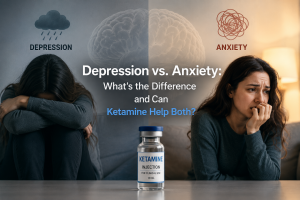
Struggling to tell depression and anxiety apart? Learn key differences and how IV ketamine targets shared neural pathways to relieve both conditions.
 Optimized by Seraphinite Accelerator