Complex PTSD vs PTSD: Why the Difference Changes Treatment
A board-certified anesthesiologist explains who qualifies for ketamine infusion therapy, what we screen for, and who we turn away. Milford & Westport, CT.

Ask most people to describe OCD and you get handwashing, light switches, counting, a door checked eleven times before bed. Visible things. Things another person in the room could see happening.
Now picture someone sitting at a desk, perfectly still, who has spent the last forty minutes silently replaying a conversation from six years ago to determine whether they are a bad person. Nothing is visible. Nothing would show up on a camera. And by every clinical measure, that is OCD too.
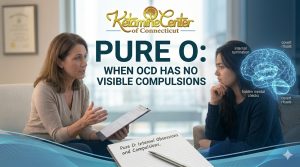
People call this Pure O. It is one of the most misunderstood presentations in mental health, and the people living with it often go a decade or more before anyone puts the right name to it.
Pure O is short for purely obsessional OCD. It is not a diagnosis. It does not appear in the DSM-5-TR, and no psychiatrist will put it on a chart.
More importantly, the name is inaccurate in a way that matters clinically. Research on people who identify with the term consistently finds that they do have compulsions. The compulsions are just happening inside their heads.
That distinction is not academic. It changes the treatment. If you believe you have obsessions and no compulsions, the standard treatment for OCD looks like it does not apply to you. Once you can see that the mental reviewing, the arguing with yourself, the endless searching for certainty are compulsions, the same treatment that works for handwashing works for you.

Pure O is short for purely obsessional OCD. It is not a diagnosis. It does not appear in the DSM-5-TR, and no psychiatrist will put it on a chart.
More importantly, the name is inaccurate in a way that matters clinically. Research on people who identify with the term consistently finds that they do have compulsions. The compulsions are just happening inside their heads.
That distinction is not academic. It changes the treatment. If you believe you have obsessions and no compulsions, the standard treatment for OCD looks like it does not apply to you. Once you can see that the mental reviewing, the arguing with yourself, the endless searching for certainty are compulsions, the same treatment that works for handwashing works for you.
A compulsion is anything you do to reduce the distress an obsession creates. It does not have to be physical. These are the common internal versions.
| The compulsion | What it looks like from the inside |
|---|---|
| Mental reviewing | Replaying an event over and over to check what really happened or what you really meant |
| Mental checking | Scanning your own body or feelings for a reaction, then checking whether the reaction means something |
| Reassurance seeking | Asking people the same question in slightly different forms, or asking yourself and answering |
| Neutralizing | Replacing a bad thought with a good one, praying in a set way, or repeating a phrase internally |
| Researching | Hours of reading articles, forums, and symptom lists looking for the one that finally settles it |
| Avoidance | Staying away from people, places, films, or topics that might set the thought off |
| Arguing with the thought | Building a legal case in your head for why you are not the thing you fear you are |
Every one of these gives relief for a few minutes. That is exactly the problem. The relief is what teaches the brain that the thought was dangerous and needed handling, which makes the next one arrive louder.
Obsessions in this presentation tend to cluster around a small number of themes, and they share a family resemblance. They attach to whatever a person would find most unacceptable about themselves.
The content varies. The mechanism does not. In every case there is a thought, a spike of distress, and something done internally to make the distress stop.
This is the part I want to state plainly, because it is the single most common misunderstanding.
Intrusive thoughts are close to universal. Studies of people with no psychiatric diagnosis at all find that the overwhelming majority experience unwanted intrusive thoughts, including violent or taboo ones. Most people notice the thought, find it odd, and move on within seconds.
The difference in OCD is not the thought. It is the meaning attached to it and the effort spent responding to it.
There is also a pattern clinicians see consistently: the obsession is almost always the opposite of the person’s values. People terrified of harming children are typically the ones most careful around them. That is not a coincidence, and it is not reassurance. It is a structural feature of how the disorder picks its targets.
A note worth taking seriously. If you are reading this article to work out whether your thoughts mean something about you, that reading is itself a compulsion. I am not saying stop reading. I am saying notice what you are doing, because noticing it is the first skill that treatment teaches.
ERP is a specific form of cognitive behavioral therapy and it is the established first-line treatment for OCD, including this presentation. The principle is straightforward and uncomfortable: you deliberately sit with the trigger and do not perform the compulsion.
For mental compulsions, ERP has to be adapted, because the ritual is happening inside. A therapist trained specifically in OCD will work on noticing the mental ritual and declining to complete it. This is a real specialization. A general talk therapist, however skilled, can unintentionally make OCD worse by providing the reassurance the disorder is asking for.
If you take one practical thing from this article, make it this: ask any prospective therapist directly whether they are trained in ERP for OCD.
SSRIs have good evidence for OCD, with two differences from how they are used in depression. The effective doses are often higher, and the trial needs to be longer, commonly ten to twelve weeks before you can judge whether it is working. People abandon these medications at six weeks and conclude they failed when they were never given a fair test.
Our clinic treats OCD, so read what follows knowing that I have an interest in the subject. I am going to give you the unflattering version anyway.
The evidence for ketamine in OCD is real but it is early, and it is nowhere near as strong as the evidence in depression. A 2026 systematic review pulled together fifteen studies across roughly 118 participants in total, and only three of those were randomized controlled trials. That is a small body of work.
What it found: a single infusion produced a rapid reduction in obsessions for somewhere around half to sixty percent of participants. The effect was genuine and it was fast. It was also short-lived, generally fading within about a week when ketamine was used on its own.
The more interesting finding was that combining infusions with ERP therapy produced improvements that held for weeks to months. That fits the mechanism. Ketamine appears to open a window of increased neuroplasticity, and ERP is the thing that uses the window. Ketamine alone gives you the window and nothing to put in it.
There is also a safety signal specific to OCD that deserves stating. The same review identified delayed dysphoria and, in a subset of patients, suicidal ideation appearing 24 to 48 hours after infusion. This pattern is not typical of what is seen in depression trials. It is a reason for careful screening, for a psychiatrist or therapist to be actively involved, and for follow-up in the days after a session rather than only during it. It is also a reason to be sceptical of any clinic that presents ketamine for OCD as routine.
The honest summary: ERP with a properly trained therapist is the first thing to try. Ketamine is worth a conversation if you have been through ERP and adequate medication trials without enough relief, and it makes the most sense alongside therapy rather than instead of it. You can read what we screen for before treating anyone if you want to know how that assessment works.
The most useful next step is an evaluation with someone who treats OCD specifically, and saying the actual content of the thoughts out loud to them.
I know that is the hardest part. People rehearse it for years. But a clinician who treats OCD has heard every theme in this article many times over, will not be shocked, and cannot help you with a version of the problem you have sanitized. The specific content is what lets them recognize the pattern.
Whatever you decide about treatment, the thing to take away is that this has a name, it is well understood, and it responds to the right treatment.
If there is one thing I would want someone to take from this, it is that the silence is the worst part of it, and the silence is the part you can change first.
People carry these thoughts around for years believing they are the only person who has ever had them. They are not. The themes in this article come up again and again in clinics everywhere, in almost the same words, from people who have no idea anyone else has said them before. A clinician who treats OCD has heard all of it. Nothing you say is going to be the thing that finally shocks them.
The other thing worth holding onto is that this is treatable, and it is treatable even if it has been going on since you were a child. Nobody gets graded on how long it took them to ask. Plenty of people start treatment in their forties for something that began at fifteen, and they still get better.
You do not have to have the right words for it. You can walk into an appointment and say “I think I might have OCD and I have never told anyone this,” and a good clinician will take it from there. That sentence is enough.
Because ketamine is a potent anesthetic that temporarily affects your reflexes, motor coordination, and visual perception, these rules are not optional. Our full preparation and recovery guide covers the rest.
It is a widely used informal term, not a formal diagnosis. It describes OCD where the compulsions are mental rather than physical. Research consistently finds that people who identify with the term do have compulsions, in the form of mental reviewing, reassurance seeking, neutralizing, and avoidance.
Does having violent or disturbing intrusive thoughts mean I am dangerous?
No, and this is the question people are most afraid to ask out loud. Intrusive thoughts of this kind are reported by the large majority of people with no psychiatric diagnosis at all. What distinguishes OCD is not the thought, it is the distress the thought causes and the effort spent trying to neutralize it. The horror you feel about the thought is itself evidence that it runs against everything you value. That said, I would rather you hear this from a clinician sitting in front of you than from a webpage, because that is the version that actually sticks.
Anxiety worries tend to move between plausible real-world topics. OCD obsessions fix on a specific feared idea and generate a demand for certainty that cannot be satisfied. The distinction matters because the treatments differ, and OCD treated as general anxiety often does not improve.
The research is promising but early, with a small number of randomized trials and a modest total number of participants. Single infusions have produced rapid reductions in obsessions for a substantial share of participants, though the effect is usually short-lived on its own and appears to last considerably longer when paired with ERP therapy. It is not a replacement for ERP and is generally considered after standard treatments have been tried. If you are weighing it up, it helps to know what an infusion actually involves.
Because ordinary supportive therapy can accidentally supply reassurance, and reassurance is the very thing the disorder is fishing for. A kind therapist telling you that of course you would never do that feels good for about an hour, then the doubt comes back hungrier. ERP is built specifically to stop feeding it. It is worth asking a prospective therapist about this directly, and a good one will not be offended by the question.
Yes. Long duration makes OCD more entrenched, not untreatable. People start treatment in their thirties, forties and fifties for something that began in childhood, and they respond. The years you spent without help are not a strike against you, and no good clinician is going to treat them that way.

232 Boston Post Rd Suite 13, Milford, CT 06460
1720 Post Rd E Suite 222, Westport, CT 06880
Treatments are strictly supervised by a board-certified physician, Dr. Gino Ang. Ketamine is prescribed only for adults with major depressive disorder who have not responded adequately to at least two different antidepressants. All treatment sessions are conducted in a controlled clinical environment, and Ketamine is administered under the physician’s direct supervision.
Patients must follow strict protocols:
If you are experiencing symptoms of depression and want to explore ketamine treatment, please contact us to schedule a consultation at our Milford or Westport clinic. All care is personalized to ensure safety, efficacy, and adherence to clinical guidelines.

Board-Certified Anesthesiologist
This content was reviewed for medical accuracy by Dr. Gino of the Ketamine Center of CT. This information is for educational purposes and is not a substitute for professional medical advice, diagnosis, or treatment. Use of this site does not establish a doctor-patient relationship.
A board-certified anesthesiologist explains who qualifies for ketamine infusion therapy, what we screen for, and who we turn away. Milford & Westport, CT.

Pure O is not really obsessions without compulsions. A physician explains mental compulsions, why the thoughts do not mean what you fear, and what treatment works.

A board-certified anesthesiologist explains who qualifies for ketamine infusion therapy, what we screen for, and who we turn away. Milford & Westport, CT.
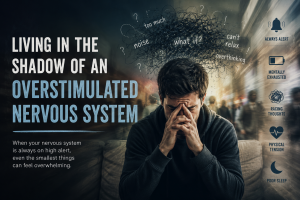
Struggling with severe anxiety or panic attacks? Discover how IV ketamine therapy breaks fear loops, promotes neuroplasticity, and offers rapid relief.

Struggling to tell depression and anxiety apart? Learn key differences and how IV ketamine targets shared neural pathways to relieve both conditions.
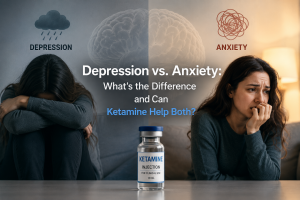
Struggling to tell depression and anxiety apart? Learn key differences and how IV ketamine targets shared neural pathways to relieve both conditions.
 Optimized by Seraphinite Accelerator