Complex PTSD vs PTSD: Why the Difference Changes Treatment
A board-certified anesthesiologist explains who qualifies for ketamine infusion therapy, what we screen for, and who we turn away. Milford & Westport, CT.

Living with both depression and anxiety usually means dealing with an exhausting cycle. Your mind races until you’re completely drained, but the moment you try to rest, a deep burnout sets in, triggering panic over everything you feel like you’re falling behind on.
It leaves most people asking the same question: Where does the depression end and the anxiety actually begin?
If you can’t tell the two apart, that isn’t a lack of self-awareness. These conditions cross paths constantly. Unpacking where they differ (and where they share the exact same root causes) is often the first real step toward finding a treatment that actually gives you relief.
Depression and anxiety share a lot of the same symptoms, including constant fatigue, disrupted sleep, and trouble concentrating. However, they pull your nervous system in completely different directions.
is primarily a disorder of energy, mood, and motivation. It brings persistent sadness, emotional numbness, hopelessness, and a loss of interest in things you used to care about. The internal monologue tends to point backward, focusing on past regrets and feelings of worthlessness.
on the other hand, is primarily a disorder of fear and hyperarousal. It often shows up as chronic overthinking, leaving you trapped in constant mental loops that leave you feeling completely drained throughout the day. Alongside physical restlessness and hypervigilance, there is a persistent sense that something bad is coming. Here, the internal monologue points forward, endlessly calculating future threats and worst-case scenarios.
| Feature | Primary Depression | Primary Anxiety |
|---|---|---|
| Dominant state | Low energy, numbness, despair | High tension, worry, hyperarousal |
| Mental focus | Ruminating on the past | Anticipating future threats |
| Physical toll | Heaviness, slowing, exhaustion | Racing heart, muscle tightness, restlessness |
| Daily impact | Hard to start or finish tasks | Over-analyzing or avoiding tasks |
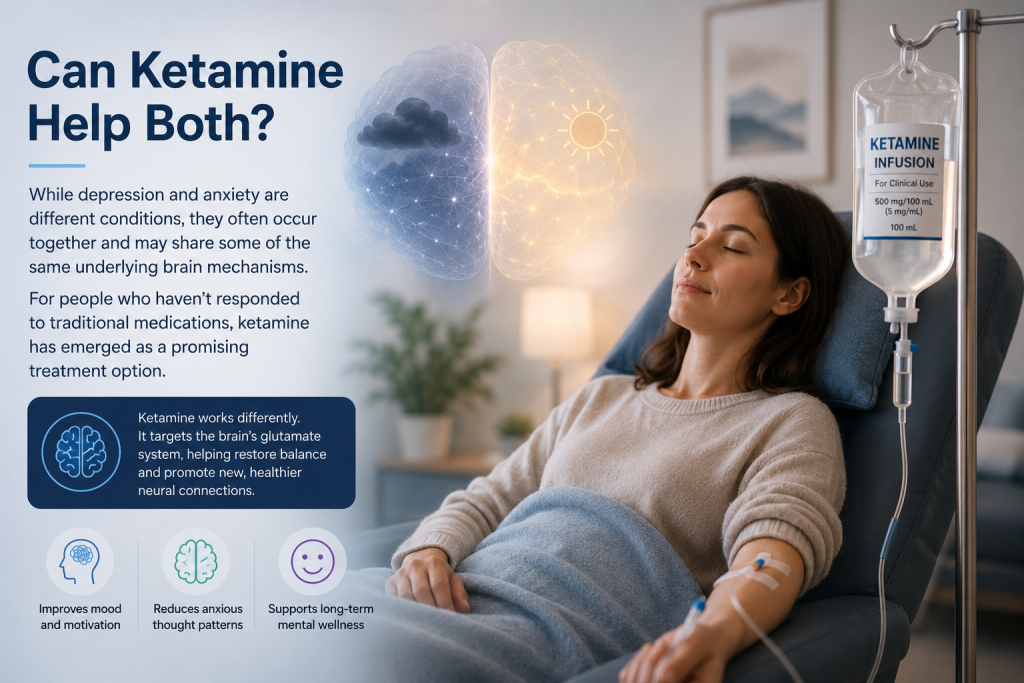
Most daily oral medications try to balance mood by gradually adjusting neurotransmitters like serotonin and norepinephrine over time. IV ketamine takes a completely different approach, targeting a biological pathway that standard daily medications leave untouched.
It comes down to glutamate, the brain’s main excitatory neurotransmitter. Ketamine blocks NMDA receptors, triggering a rapid shift in glutamate signaling that helps break the rigid neural patterns where chronic depression and high-stress anxiety usually take root.
That shift is crucial because of how chronic stress physically impacts the brain. Prolonged anxiety and depression tend to shrink and weaken synaptic connections in areas responsible for emotion and memory, like the prefrontal cortex and hippocampus. Ketamine helps reverse this by stimulating Brain-Derived Neurotrophic Factor (BDNF), a key protein that promotes structural neuroplasticity. It encourages the growth and repair of fresh synaptic connections, and unlike standard prescriptions that take weeks to show results, these physical changes often begin within hours or days.
Beyond glutamate, ketamine also targets the brain’s Default Mode Network, which serves as the internal hub for self-referential thought. Functional imaging shows that ketamine temporarily quietens this network when it becomes overactive—the exact state that fuels relentless mental loops, constant worry, and internal rumination. Quieting that network gives the mind a chance to rest, which is why many patients report their negative self-talk going still for the very first time in years.
To be completely clear about where the science stands, these mechanisms are backed by a strong and growing body of research, but every person’s nervous system responds uniquely. In published studies on treatment-resistant depression, many patients saw significant improvement after years of failed medications, while others experienced a more gradual or modest response.
If you live with high anxiety, asking whether an infusion will make your nervous system feel worse is a completely fair question. It is actually the single most common fear patients share before their very first session.
When your nervous system is already stuck in hyperdrive, the idea of entering an unfamiliar state can feel overwhelming. What usually catches patients off guard, however, is how gentle the process actually feels once it begins. Instead of triggering a panic response, the experience is designed to feel calm, quiet, and deeply grounded.
Every session at our clinics is built around clinical safety, comfort, and close oversight:
So many of our patients come to us believing they just need to try harder or accept constant burnout as their new normal. The truth is, when chronic anxiety and low mood overlap, your body’s baseline stress response gets stuck in overdrive. Recognizing that you need a different approach isn’t giving up—it is the first step toward getting your energy back.
Living with depression and anxiety can make you feel like you are running on empty, especially when balancing work, family, and daily responsibilities. So many people in their 30s, 40s, and beyond go through their days assuming this level of exhaustion is just a normal part of getting older or managing a busy life.
It isn’t. Feeling constantly drained, overwhelmed, or emotionally numb is not a personal failure, and it does not mean you are broken. It simply means your nervous system has been running in survival mode for too long.
If standard oral medications haven’t given you the relief you need, your options are far from exhausted. Exploring advanced treatments like IV ketamine therapy can help reset those deeply ingrained neural patterns, offering a new path forward when other approaches have fallen short.
Reaching out for guidance is often the hardest step, but you do not have to navigate it alone. Contact the Ketamine Center of Connecticut today to schedule a consultation at our Milford or Westport clinics, and let us help you explore whether ketamine therapy is the right choice for your recovery.
Ketamine for psychiatric conditions is an off-label use, delivered at sub-anesthetic doses under medical supervision. This article is for educational purposes and is not a substitute for medical advice. If you are in crisis, call or text 988.
Because ketamine temporarily alters your perception and relaxes your body, you are strictly prohibited from driving or operating machinery for the rest of the day following your infusion.
For your safety and absolute peace of mind, you must arrange for a trusted friend, family member, or ride service to take you home after your session. Your safety is our highest priority, and we require this plan to be in place before your treatment begins.
No solid food for 4 hours before a ketamine infusion. Clear liquids only 2 hours before the infusion.
Every session is clinically supervised with continuous, real-time monitoring of heart rate, blood pressure, and oxygen levels using hospital-grade equipment supervised by Dr. Gino Ang.
Conditions that preclude treatment include pregnancy, breastfeeding, uncontrolled or untreated high blood pressure, and untreated hyperthyroidism.
No. You generally do not need to stop prescribed daily antidepressants; ketamine is often used safely alongside existing regimens.
Clinical therapy differs by dose, intent, and environment. We use low, precise sub-anesthetic doses focused strictly on neuroplasticity and recovery rather than high-dose recreational escape.
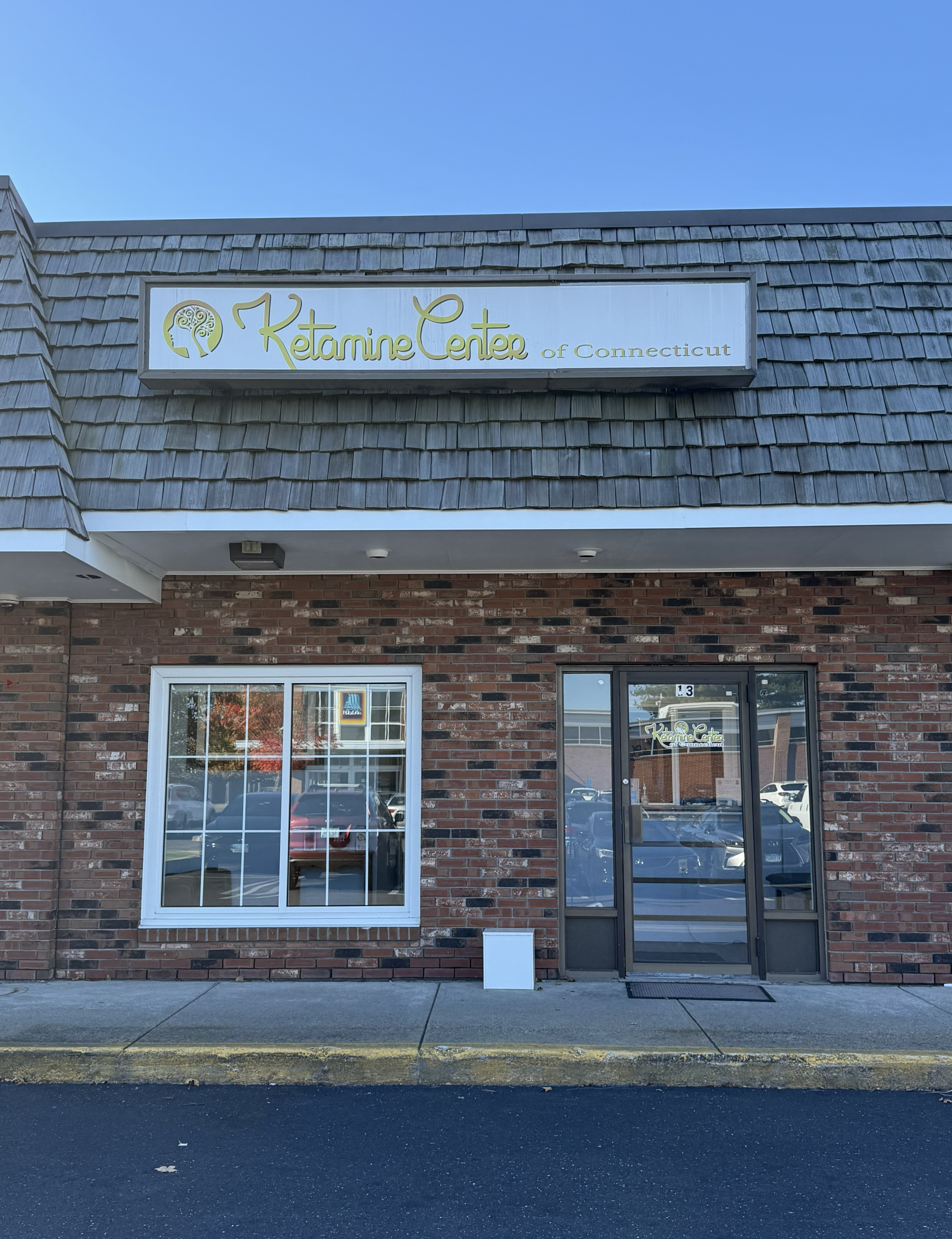
232 Boston Post Rd Suite 13, Milford, CT 06460
1720 Post Rd E Suite 222, Westport, CT 06880
Treatments are strictly supervised by a board-certified physician, Dr. Gino Ang. Ketamine is prescribed only for adults with major depressive disorder who have not responded adequately to at least two different antidepressants. All treatment sessions are conducted in a controlled clinical environment, and Ketamine is administered under the physician’s direct supervision.
Patients must follow strict protocols:
If you are experiencing symptoms of depression and want to explore ketamine treatment, please contact us to schedule a consultation at our Milford or Westport clinic. All care is personalized to ensure safety, efficacy, and adherence to clinical guidelines.

Board-Certified Anesthesiologist
This content was reviewed for medical accuracy by Dr. Gino of the Ketamine Center of CT. This information is for educational purposes and is not a substitute for professional medical advice, diagnosis, or treatment. Use of this site does not establish a doctor-patient relationship.
A board-certified anesthesiologist explains who qualifies for ketamine infusion therapy, what we screen for, and who we turn away. Milford & Westport, CT.
Pure O is not really obsessions without compulsions. A physician explains mental compulsions, why the thoughts do not mean what you fear, and what treatment works.

A board-certified anesthesiologist explains who qualifies for ketamine infusion therapy, what we screen for, and who we turn away. Milford & Westport, CT.
Struggling with severe anxiety or panic attacks? Discover how IV ketamine therapy breaks fear loops, promotes neuroplasticity, and offers rapid relief.
Struggling to tell depression and anxiety apart? Learn key differences and how IV ketamine targets shared neural pathways to relieve both conditions.
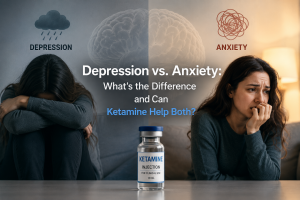
Struggling to tell depression and anxiety apart? Learn key differences and how IV ketamine targets shared neural pathways to relieve both conditions.
 Optimized by Seraphinite Accelerator