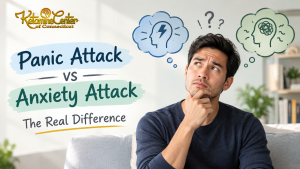
Panic Attack vs Anxiety Attack: The Real Difference
One of these terms is in the DSM-5-TR and one is not. How to tell the difference, why the wording changes what gets treated, and what actually works for panic.
Written by Dr. Gino Ang, MD, Board-Certified Anesthesiologist | Medically reviewed by Dr. Gino Ang, MD | Est. reading time: 8 minutes
Someone sat in our Westport office last year and told me she had been having anxiety attacks for about six years. Two or three a month. She described them well: the sudden wave, the heart going, the certainty that something terrible was about to happen, then twenty minutes later sitting in her car feeling wrung out and slightly embarrassed.
She had been using the wrong words the whole time, and it had cost her. What she was describing had a name, a diagnosis, and a treatment with good evidence behind it. Nobody had ever told her, partly because the term she kept using does not exist in any clinical manual.
One of these is a defined clinical term. The other is not.
Panic attack is a specific, diagnosable event with criteria in the DSM-5-TR. A clinician can confirm it, document it, and treat it.
Anxiety attack is not in the DSM at all. It is a phrase people use, and most of the time what they are describing is either a panic attack or a stretch of high anxiety that built up gradually.
I am not pointing this out to correct anyone’s vocabulary. I am pointing it out because the words you bring to an appointment change what gets assessed. “I have anxiety attacks” gets reassurance about stress. “I have sudden episodes that peak within a few minutes and include chest pain and a fear I am dying” gets a diagnostic workup.
The clinical definition has a shape to it, and the shape matters more than any single symptom.
A panic attack is an abrupt surge of intense fear or discomfort that reaches its peak within minutes. During that surge, at least four symptoms from a list of thirteen are present. The list includes pounding or racing heart, sweating, trembling, shortness of breath, a sense of choking, chest pain, nausea, dizziness, chills or heat sensations, numbness or tingling, a feeling of unreality or detachment, fear of losing control, and fear of dying.
Two parts of that definition do most of the diagnostic work.
Abrupt. It arrives. People describe it as being switched on rather than crept up on.
Peaks within minutes. This is the single most useful question I can ask someone. Not how bad it was, but how fast it got to its worst.
The National Institute of Mental Health describes the whole episode as lasting from a few minutes to an hour, sometimes longer, and notes something else worth holding onto: a panic attack itself is not life-threatening, even though it is one of the more frightening things a human body does.
Usually one of two things.
Sometimes they mean a panic attack and simply prefer the softer word. That is most of the people who say it to me.
Sometimes they mean something genuinely different: a period of mounting anxiety, building over an hour or a day or a week, with a recognisable trigger, less physically explosive but harder to shake off. That experience is real. It just does not have a separate diagnostic label, because it is usually a feature of generalised anxiety rather than an event in its own right.
| Panic attack | What people call an anxiety attack | |
|---|---|---|
| Onset | Abrupt, switched on | Gradual build |
| Time to peak | Within minutes | Hours, sometimes longer |
| Trigger | Often none identifiable | Usually an identifiable worry |
| Physical intensity | Severe, four or more defined symptoms | Milder but more sustained |
| Common fear during it | Dying, losing control, going mad | Something bad happening later |
| Afterwards | Drained, shaky, often embarrassed | Tense, tired, still worrying |
| Clinical status | Defined in the DSM-5-TR | Not a diagnostic term |
Real life is messier than that table. People have gradual anxiety that tips into a panic attack. People have panic attacks with a clear trigger. The table is a starting point for a conversation, not a test to score yourself on.
This confusion causes real distress and it is easy to clear up.
Having a panic attack does not mean you have panic disorder. NIMH is explicit that a single attack is not considered a mental disorder. Panic attacks are common, and plenty of people have one or two in a lifetime after a period of exhaustion or stress and never have another.
Panic disorder is the pattern: recurrent unexpected attacks, plus persistent worry about having more, plus changes to how you live in order to avoid them. The avoidance is often the part that does the most damage, and it is usually the part people do not mention.
The question I ask that people find clarifying. Not how often do you have attacks, but what have you stopped doing because of them. Driving on the highway, going to the supermarket alone, sitting in the middle of a row. That answer tells me more about how much this is costing you than the frequency ever does.
Clinicians separate these, and it changes the picture.
An expected attack happens in a situation that reliably sets it off, such as a flight or a crowded lift. An unexpected attack arrives with no cue at all, including out of sleep.
Unexpected attacks tend to be the more disabling kind, because there is nothing to avoid and nothing to prepare for. People with unexpected attacks often become anxious about their own body instead, scanning for the first flutter. That scanning then produces exactly the sensations they are watching for.
This part is important enough that I would rather over-emphasise it.
Several medical conditions produce episodes that look exactly like panic, and some of them are regularly mistaken for it for years. Arrhythmias such as supraventricular tachycardia are the classic example. Thyroid problems, certain hormonal conditions and some medication effects also belong on that list.
If you have never had this assessed physically, get it assessed before you accept a psychiatric explanation for it. An ECG is quick and cheap. We wrote a separate article about the symptoms people mistake for a heart problem, and the mistake that runs in the other direction, because it is a bigger problem than most people realise.
Any question about your own medications belongs with the doctor who prescribes them. Nothing in this article is advice about what to take or change.
The good news about panic specifically is that it responds well to treatment, better than most people expect.
CBT for panic is the first-line treatment and it has a strong evidence base. A specific component called interoceptive exposure is the part that tends to surprise people: you deliberately bring on the physical sensations, through things like breathing exercises or spinning, in order to learn that the sensations themselves are not dangerous.
It sounds counterintuitive and it works. If you speak to a therapist about panic, ask whether they use it.
Several medication options have good evidence for panic disorder. Which one, at what dose, and for how long is a decision for a psychiatrist or your primary care physician who knows your history. I am not going to make suggestions about that here.
Our clinic treats anxiety, so weigh this accordingly, and I am going to be conservative.
Ketamine is not a first-line treatment for panic. The evidence base for ketamine in anxiety disorders is thinner than it is in depression, and panic disorder specifically has barely been studied as its own condition. Anyone presenting infusions as an established treatment for panic attacks is going well beyond what the research supports.
Where it becomes a reasonable conversation is when panic sits alongside depression that has not responded to at least two antidepressants, or alongside another condition we do treat. In that situation we would look at the whole picture rather than at the panic in isolation, and you can read what we screen for before treating anyone.
If panic is the only thing going on, CBT with a therapist who knows interoceptive exposure is where I would start, and I would say that to anyone who called.
The most useful thing you can do is change the sentence you bring to your next appointment.
Instead of “I get anxiety attacks,” try describing the shape: how fast it reaches its worst, how long it lasts, which physical symptoms show up, whether there is a trigger, and what you have stopped doing because of it. Those five details are most of what a clinician needs.
And if you have never had a physical workup for these episodes, ask for one. Not because it is likely to be your heart, but because finding out is straightforward and the alternative is years of treating the wrong thing.
The woman I mentioned at the start had panic disorder with a significant avoidance pattern. She started CBT with interoceptive exposure. It was uncomfortable for a few weeks and then it was not.
Six years is a long time to carry something treatable, and the reason she carried it was partly a word. She had a description that sounded like a personality trait rather than a condition, so nobody assessed it as one.
If any of this sounds like your experience, the useful move is not to work out which label is correct. It is to describe the episodes accurately to someone who can assess them. The label is their job. The description is yours.
The experience is real. The term is not a clinical one and does not appear in the DSM-5-TR. Most people using it are describing either a panic attack or a period of escalating anxiety. Describing the episode rather than naming it is more useful at an appointment.
The clearest marker is speed. A panic attack comes on abruptly and reaches peak intensity within minutes, with at least four physical or cognitive symptoms such as a racing heart, chest pain, shortness of breath, trembling, numbness, a sense of unreality, or a fear of dying. Anxiety that builds gradually over hours is a different pattern.
The peak arrives within minutes. NIMH describes the whole episode as lasting from a few minutes to an hour, occasionally longer. The drained, shaky feeling afterwards can persist well beyond the attack itself.
No. A single attack is not considered a disorder. Panic disorder involves recurrent unexpected attacks together with ongoing worry about more of them and changes to how you live in order to avoid them.
A panic attack itself is not life-threatening, though it can feel like it is. The important caveat is that several medical conditions, including some arrhythmias, produce very similar episodes. If these have never been assessed physically, that assessment is worth having before accepting a psychiatric explanation.
Cognitive behavioural therapy is first-line and has strong evidence, particularly a component called interoceptive exposure. Medication options also exist with good evidence, and those decisions belong with your own prescriber. Ketamine is not a first-line treatment for panic.
It is not established for that. The evidence for ketamine in anxiety disorders is considerably thinner than in depression, and panic disorder specifically has barely been studied. It becomes a reasonable discussion when panic occurs alongside depression that has not responded to standard treatment, rather than on its own.
Because ketamine is a potent anesthetic that temporarily affects your reflexes, motor coordination, and visual perception, these rules are not optional. Our full preparation and recovery guide covers the rest.
External sources are linked for verification. Interpretation of this material is the author’s own and does not imply endorsement by the publishers or their institutions.

232 Boston Post Rd Suite 13, Milford, CT 06460
1720 Post Rd E Suite 222, Westport, CT 06880
Treatments are strictly supervised by a board-certified physician, Dr. Gino Ang. Ketamine is prescribed only for adults with major depressive disorder who have not responded adequately to at least two different antidepressants. All treatment sessions are conducted in a controlled clinical environment, and Ketamine is administered under the physician’s direct supervision.
Patients must follow strict protocols:
If you are experiencing symptoms of depression and want to explore ketamine treatment, please contact us to schedule a consultation at our Milford or Westport clinic. All care is personalized to ensure safety, efficacy, and adherence to clinical guidelines.

Board-Certified Anesthesiologist
This content was reviewed for medical accuracy by Dr. Gino of the Ketamine Center of CT. This information is for educational purposes and is not a substitute for professional medical advice, diagnosis, or treatment. Use of this site does not establish a doctor-patient relationship.
One of these terms is in the DSM-5-TR and one is not. How to tell the difference, why the wording changes what gets treated, and what actually works for panic.

Why no alcohol for 24 hours before a ketamine infusion, what happens if you drank last night, and why daily drinkers should never stop on their own first.
Why no alcohol for 24 hours before a ketamine infusion, what happens if you drank last night, and why daily drinkers should never stop on their own first.
Complex PTSD adds three symptoms PTSD does not cover, and it is not in the DSM-5. A physician explains the difference and why it changes your treatment plan.
Pure O is not really obsessions without compulsions. A physician explains mental compulsions, why the thoughts do not mean what you fear, and what treatment works.

A board-certified anesthesiologist explains who qualifies for ketamine infusion therapy, what we screen for, and who we turn away. Milford & Westport, CT.