
Anxiety Symptoms People Mistake for a Heart Problem
can anxiety cause chest pain, anxiety or heart attack how to tell, heart palpitations anxiety, SVT misdiagnosed as anxiety, why do my hands tingle during panic attack, non-cardiac chest pain
Written by Dr. Gino Ang, MD, Board-Certified Anesthesiologist | Medically reviewed by Dr. Gino Ang, MD | Est. reading time: 9 minutes
This is the question I get asked earliest and most often, usually before anything about safety or how the infusion feels. People want to know what they are signing up for. How many appointments, how many weeks, and whether this is a thing that ends.
The short answer is six infusions over two to three weeks to start. The longer answer, and the one that actually helps you plan, depends on what you are being treated for, and I want to give you real numbers from the research rather than a comfortable range
If you’re considering ketamine therapy for depression, anxiety, PTSD, OCD, bipolar disorder, chronic pain, or suicidality, one of the most common questions you may have is:
“How many infusions will I need, and how long will the benefits last?”
At Ketamine Center of Connecticut, we want every patient to feel informed, comfortable, and confident in their treatment plan. This guide explains what you can expect from your ketamine infusion series—based on current research, clinical practice, and the experience of our medical team.
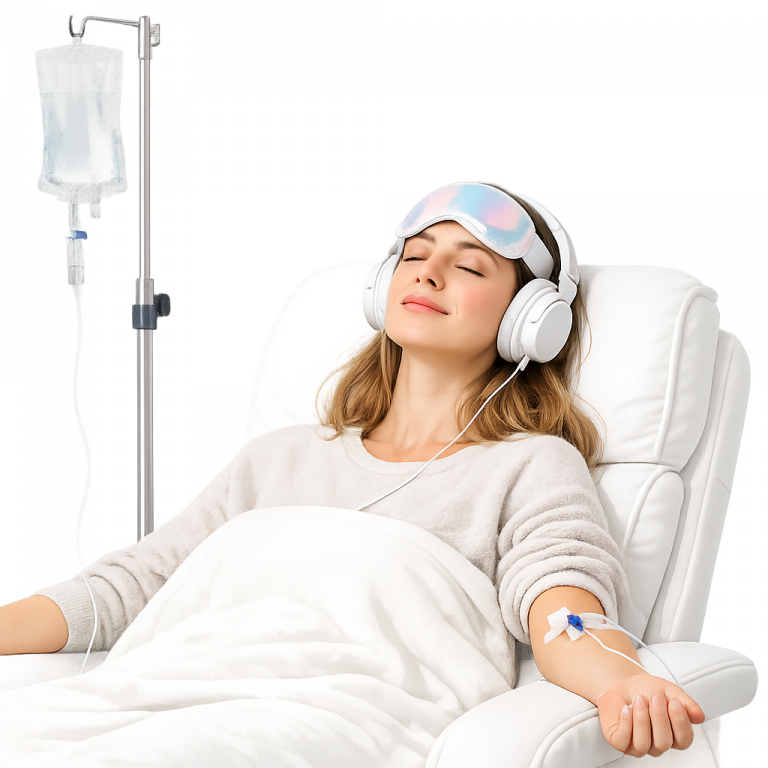
The standard induction series is six IV infusions over two to three weeks, usually two or three sessions per week rather than spread out.
The clustering is deliberate. Ketamine is thought to work by promoting synaptic plasticity, the brain’s capacity to form new connections. A single infusion opens that window briefly. Repeated infusions close together appear to hold it open long enough for the change to consolidate. Spacing six infusions across three months would not be the same treatment.
After the sixth, we reassess. Some people are done for a while. Some move to boosters. Some, honestly, have not responded, and we tell them so rather than selling a seventh.
It is not a marketing convention. It comes from the trials.
The most cited is a study at Mount Sinai in which 24 people with treatment-resistant depression received up to six infusions three times weekly over twelve days. The overall response rate at the end of the series was 70.8 percent, in a group who had already failed multiple antidepressants.
The PTSD work used the same shape. Six infusions, three times weekly, over two weeks.
Sooner than most people expect, and this is one of the genuine differences from daily antidepressants.
In responders, change often shows up after the first or second infusion. People describe it as the heaviness lifting slightly, or noticing that they slept, or realising a few hours went by without the usual background noise. In the PTSD trial, improvement in responders appeared within 24 hours of the first infusion.
The fuller and steadier effect usually comes after the complete series. Early change tends to be uneven, good for a day and then partly gone, which is normal and not a sign it is failing.
Worth knowing in advance. If you reach the third infusion with no change at all, that is meaningful information. Most people who respond show something by then. We would rather tell you honestly at that point than encourage you to finish the series out of sunk cost.
Here I want to be more precise than most pages on this topic, including the earlier version of this one.
Relief after a completed series is real, and for most people it is measured in weeks rather than months without further treatment. The published figures vary by condition, and you should see them.
| Condition | What the trials found |
|---|---|
| Treatment-resistant depression | Six infusions over twelve days produced a 70.8 percent response rate. In responders, the median time to relapse after the final infusion was 18 days without maintenance treatment. |
| PTSD | Six infusions over two weeks: 67 percent achieved at least a 30 percent symptom reduction, against 20 percent on an active comparator. Median benefit in responders lasted roughly 27.5 days. |
| OCD | Weaker and less consistent. A controlled trial of six infusions found 40 percent response versus 20 percent on comparator after the sixth, falling to 6 percent versus 0 percent at four weeks. Best evidence suggests pairing infusions with ERP therapy rather than using them alone. |
| Anxiety and bipolar depression | Studied less extensively than unipolar depression. Response patterns generally resemble depression, and treatment is individualized with the patient’s psychiatrist involved. |
| Chronic pain conditions | Variable, from weeks to months depending on the condition and its severity. Protocols often differ from mental health dosing. |
Some people do hold relief for several months. That happens, and it is a very good outcome. It is not the average, and I would rather you plan around the median and be pleasantly surprised than plan around the best case and feel misled in week four.
One more thing the numbers do not capture. Those medians come from studies where ketamine was given largely on its own. In practice, people who continue therapy, keep their psychiatric medications stable, and sleep properly tend to hold their gains longer. That is not a sales line, it is the most consistent pattern I see.
Many people do, and given the relapse figures above, that should not be a surprise.
A typical booster is a single infusion every four to eight weeks, adjusted to how you actually track rather than to a fixed calendar. Some people stretch to three months. Some need a tighter interval for a while, then stretch out later.
Boosters are optional. They are also the mechanism by which the benefit of the initial series is extended rather than allowed to fade. Deciding in advance that you will do the six and nothing else is a reasonable choice, but it should be a choice made with the relapse timeline in front of you.
The six-infusion series is a starting protocol, not a prescription every person receives identically.
The six-infusion series is a starting protocol, not a prescription every person receives identically.
Every plan at our Milford and Westport offices is built around your medical history, your current medications, how severe your symptoms are, and how you respond as we go. Dosing is weight-based. Blood pressure is checked before every session. Vitals are monitored continuously with Caretaker wireless technology rather than a cuff that squeezes your arm every five minutes.
We also adjust. If infusion three shows nothing, we say so. If you respond quickly and want to stretch your boosters, we work with that. A clinic that runs the identical protocol on every person regardless of what is happening is not personalizing anything, whatever the website says.
Six infusions over two to three weeks is the standard induction series. In the most cited trial, six infusions over twelve days produced a response in about 71 percent of people with treatment-resistant depression. Most people who respond need booster infusions afterward to maintain it.
Without maintenance, the median time to relapse in depression responders was 18 days after the final infusion. In PTSD, median benefit lasted roughly four weeks. Some people hold relief for several months, but weeks is the more realistic planning figure, which is why boosters are usually part of the conversation.
Not necessarily, and that is a decision reviewed as you go rather than fixed at the start. Some people complete a series, taper boosters over time and stop. Others use periodic maintenance for a long period, much as they would with any ongoing treatment. Nobody should be signing you up for a lifetime plan on day one.
Most responders show something by the second or third infusion. If you reach the third with no change, we will discuss it honestly rather than pushing you to finish. Depending on your situation the next step may be Spravato, TMS, or a different medication strategy with your psychiatrist.
The trial evidence used the same six infusions over two weeks, with 67 percent of participants achieving meaningful symptom reduction. Benefit lasted a median of about four weeks, so maintenance and concurrent trauma therapy are usually part of the plan. We cover this in more detail in our article on ketamine infusions for PTSD.
Yes. No solid food for at least six hours beforehand, and clear liquids only up until two hours before. Our preparation and recovery guide covers the full instructions.
Ketamine has been FDA approved as an anesthetic since 1970. Its use for depression and other mental health conditions is off-label, which is a common and legal practice supported by substantial research. Spravato, the esketamine nasal spray, is FDA approved specifically for treatment-resistant depressio
Because ketamine is a potent anesthetic that temporarily affects your reflexes, motor coordination, and visual perception, these rules are not optional.
Ketamine treatment is available at our two Connecticut locations:
232 Boston Post Rd Suite 13, Milford, CT 06460
1720 Post Rd E Suite 222, Westport, CT 06880
Treatments are strictly supervised by a board-certified physician, Dr. Gino Ang. Ketamine is prescribed only for adults with major depressive disorder who have not responded adequately to at least two different antidepressants. All treatment sessions are conducted in a controlled clinical environment, and Ketamine is administered under the physician’s direct supervision.
Patients must follow strict protocols:
If you are experiencing symptoms of depression and want to explore ketamine treatment, please contact us to schedule a consultation at our Milford or Westport clinic. All care is personalized to ensure safety, efficacy, and adherence to clinical guidelines.
External studies are linked for verification. Interpretation of this research is the author’s own and does not imply endorsement by the researchers or their institutions.

Board-Certified Anesthesiologist
This content was reviewed for medical accuracy by Dr. Gino of the Ketamine Center of CT. This information is for educational purposes and is not a substitute for professional medical advice, diagnosis, or treatment. Use of this site does not establish a doctor-patient relationship.
can anxiety cause chest pain, anxiety or heart attack how to tell, heart palpitations anxiety, SVT misdiagnosed as anxiety, why do my hands tingle during panic attack, non-cardiac chest pain

One of these terms is in the DSM-5-TR and one is not. How to tell the difference, why the wording changes what gets treated, and what actually works for panic.

Why no alcohol for 24 hours before a ketamine infusion, what happens if you drank last night, and why daily drinkers should never stop on their own first.

Why no alcohol for 24 hours before a ketamine infusion, what happens if you drank last night, and why daily drinkers should never stop on their own first.

Complex PTSD adds three symptoms PTSD does not cover, and it is not in the DSM-5. A physician explains the difference and why it changes your treatment plan.

Pure O is not really obsessions without compulsions. A physician explains mental compulsions, why the thoughts do not mean what you fear, and what treatment works.